We are about to launch our educational content at ibbe, and I want to share the framework we built for it. Some of these choices might seem extreme, but we have a deliberate reason for every single one. We spent a lot of time thinking about what actually works in education and what is just noise. This framework is the result of that thinking.
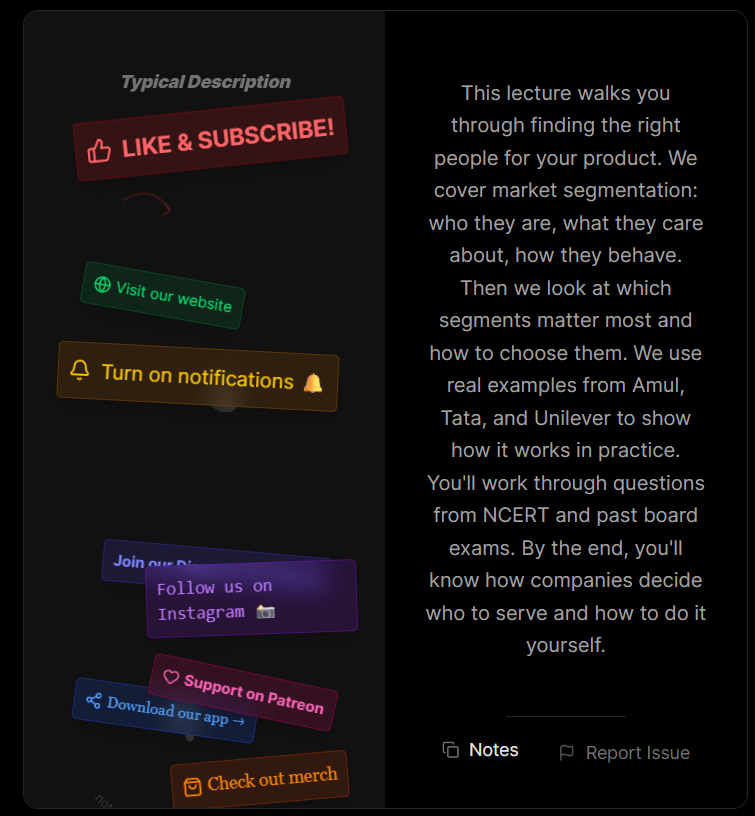
Our first decision is perhaps the most unconventional. You will find zero requests to like, share, or subscribe anywhere in our content. There are no reminders in the videos, the slides, or the descriptions. When you focus on chasing metrics, you inevitably stop serving students. Many creators optimize for engagement by dragging out explanations or adding artificial cliffhangers just to keep people watching. That works for entertainment, but it is harmful for education.
When a student sits down to learn, their goal is to understand the material and move on with their day. My job is to help them do that as efficiently as possible. Asking for likes signals that our channel growth matters more than a student's time. We want to grow through word of mouth, exceptional quality, and actual results. When students are stressed about exams and hear a sales pitch before a lecture even starts, trust is compromised. We want to eliminate that transaction entirely.
This same philosophy applies to how our teachers behave during lectures. We do not allow loud shouting, vulgar jokes, or unnecessary jargon. Teachers often use these tactics to grab attention or sound authoritative, but they cheapen the learning experience and break focus. True engagement comes from clear explanations, logical structure, and great visuals. If a technical term is necessary, we define it clearly before moving forward so that knowledge remains accessible.
We are also removing all friction from accessing resources. When a teacher mentions lecture notes, the link will lead directly to the file download. You will not see prompts to visit our website, download our app, or sign up for a newsletter just to get a PDF. Forcing students to jump through marketing hoops destroys their learning momentum. By the time someone navigates a complex website, their focus is gone. We choose to prioritize learning over collecting email addresses.
Because of this, our video descriptions will be entirely free of marketing links and promotional buttons. The description will contain exactly two things, which are the link to the notes and a link to our feedback form. Anything else is a distraction that competes for a student's attention. The lecture space should be treated as something sacred, dedicated purely to the transfer of knowledge. If people want to learn more about ibbe, they can easily find us on their own.
Our teachers are required to put away their phones an hour before going live and keep them away until the lecture ends. Presence matters deeply in education. When a teacher checks their phone mid-explanation, they send a message that something else is more important than the students. This causes students to check out mentally. We want our teaching to be treated with the seriousness and focus it deserves.
Every single lecture will remain under three hours, regardless of how large the chapter is. Human attention and memory retention drop drastically after this point. Sitting through marathon sessions usually results in looking at words without processing them. If a topic is massive, we will divide it across multiple digestible sessions. This constraint forces us to be sharper, to cut the fluff, and to focus entirely on core concepts.
Inside these windows, we design specific moments for active recall. Instead of letting students passively watch a screen, our teachers will regularly pause to ask strategic questions. These include textbook problems, questions from previous years, and custom prompts aligned with our framework. Testing yourself during a lecture strengthens memory pathways and highlights what you actually understand, allowing students to learn the material and practice for exams at the same time.
We have also decided to turn off the live chat. While live chat is common today, it quickly turns into a space for spam, inside jokes, and off-topic distractions. It forces teachers to split their attention between delivering a clear lesson and monitoring a chaotic scrolling text. When a teacher stops to answer a random question, the momentum of the explanation is broken for everyone else.
To replace chat, we built a streamlined feedback system. A dedicated team monitors each lecture in real time. Students can click a clean, anonymous link in the description to instantly submit an urgent question or report a technical issue. This input appears on a screen for the teacher within a split second. Our internal team filters out the noise, ensuring the teacher only sees what is genuinely important without disrupting the flow of the class.
Finally, our teachers arrive at least one hour before the stream begins. This time is used for technical checks, reviewing materials, and mental preparation. Rushing creates avoidable mistakes and unnecessary stress, which easily transfers to the audience. When the stream starts, the teacher is calm and the technology works perfectly. It is a quiet form of respect for the process and the students.
These choices might seem intense, but they come from my own experiences as a student. I remember the frustration of long marketing pitches, distracting jokes, confusing website navigation, and overlong sessions. How we teach matters just as much as what we teach. At ibbe, we are building an environment that puts learning first, second, and third, so that students can focus on what truly matters.